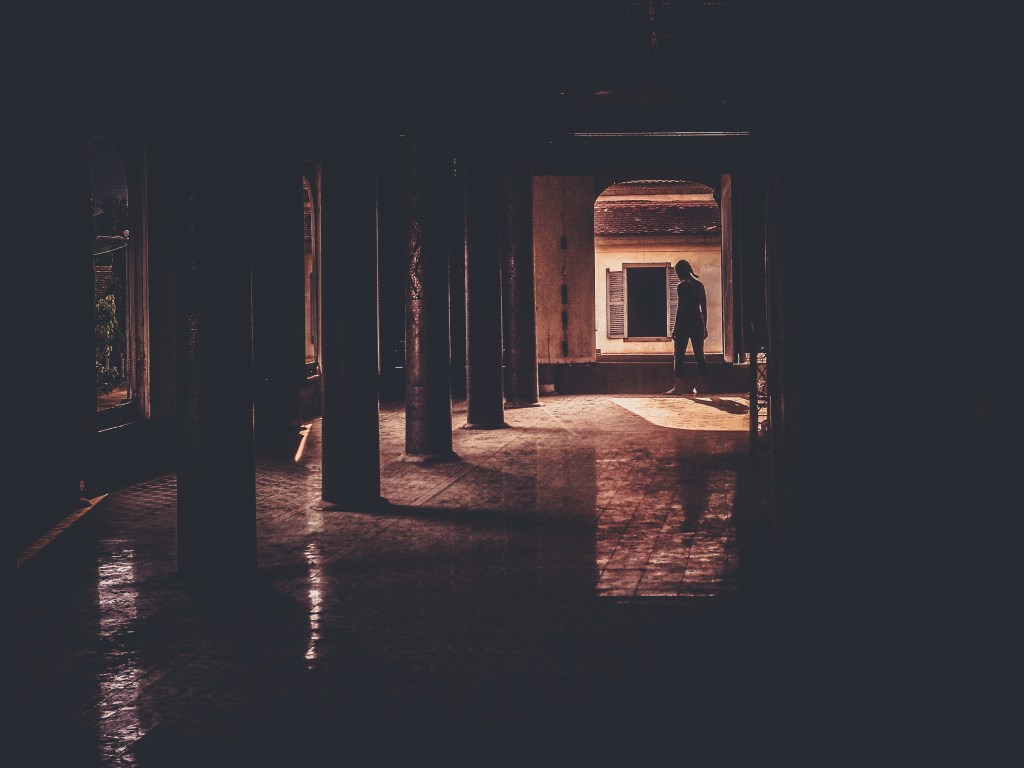
Cocoon


Awakening


Regeneration


Maiden Voyage


Blossom


Harmony

Conquer


The Crossing


Metamorphosis


The End
Location: Kampot and Kampong Cham, Cambodia
Photographer: Simon Slater
Model: Reyna Resognia
Travel Essays by Simon Slater


Too often on the increasingly congested highway of the Southeast Asian banana pancake trail, you hear of some ‘amazing’ place that people have just returned from. Some wide-eyed European backpacker will excitedly drop this adjective with a, eye-rolling, head-bobbing conviction as if they’d been to heaven and back. I was in Sihanoukville, a rapidly touristed town in Southern Cambodia when I got wind of one of these revered places that people insist you have to visit.
Kampot, a French Colonial town just two hours along the coast toward Vietnam is attracting a lot of hype. After realizing that Sihanoukville, which had a fairly rough and ready vibe when I’d visited a few years prior, had lost much of it’s rustic appeal from increased tourism and hotel developments, my disappointment subsided at the prospect of heading out east.

Fast forward a few days and my brother and I were clunking along a dusty road out of Kampot town center and into the rural sticks. Lush green fields of rice paddies dotted with water buffalo surrounded us, as did the country’s distinctive pom pom-esque palm trees sporadically sprouting up into the bold blue sky.

If the journey to get there was like a National Geographic magazine come to life then Ganesha, an eco guesthouse intertwined with its natural surroundings, sealed the deal. There were mango trees in the backyard, a giant blue gecko patrolling the side of our riverside hut, and fireflies as nightlights.
Heaven on earth.


It wasn’t just Ganesha’s beautifully cultivated environment that was worth the journey; rural Kampot is beyond gorgeous. Rent a scooter or bicycle and there is ample opportunity to blissfully further your descent into the unknown along the dirt tracks, passing through small villages whilst interacting with locals, regardless of the language barrier.


They say that Cambodia is one of the friendliest countries in the world and I completely agree. Not only did we find ourselves communicating through hand signals and broken French (they speak a mix of both French and Khmer around Kampot) with people of all ages, but we even spent the day road tripping with a kid who had struck up a conversation with us whilst we were riding parallel to each other.


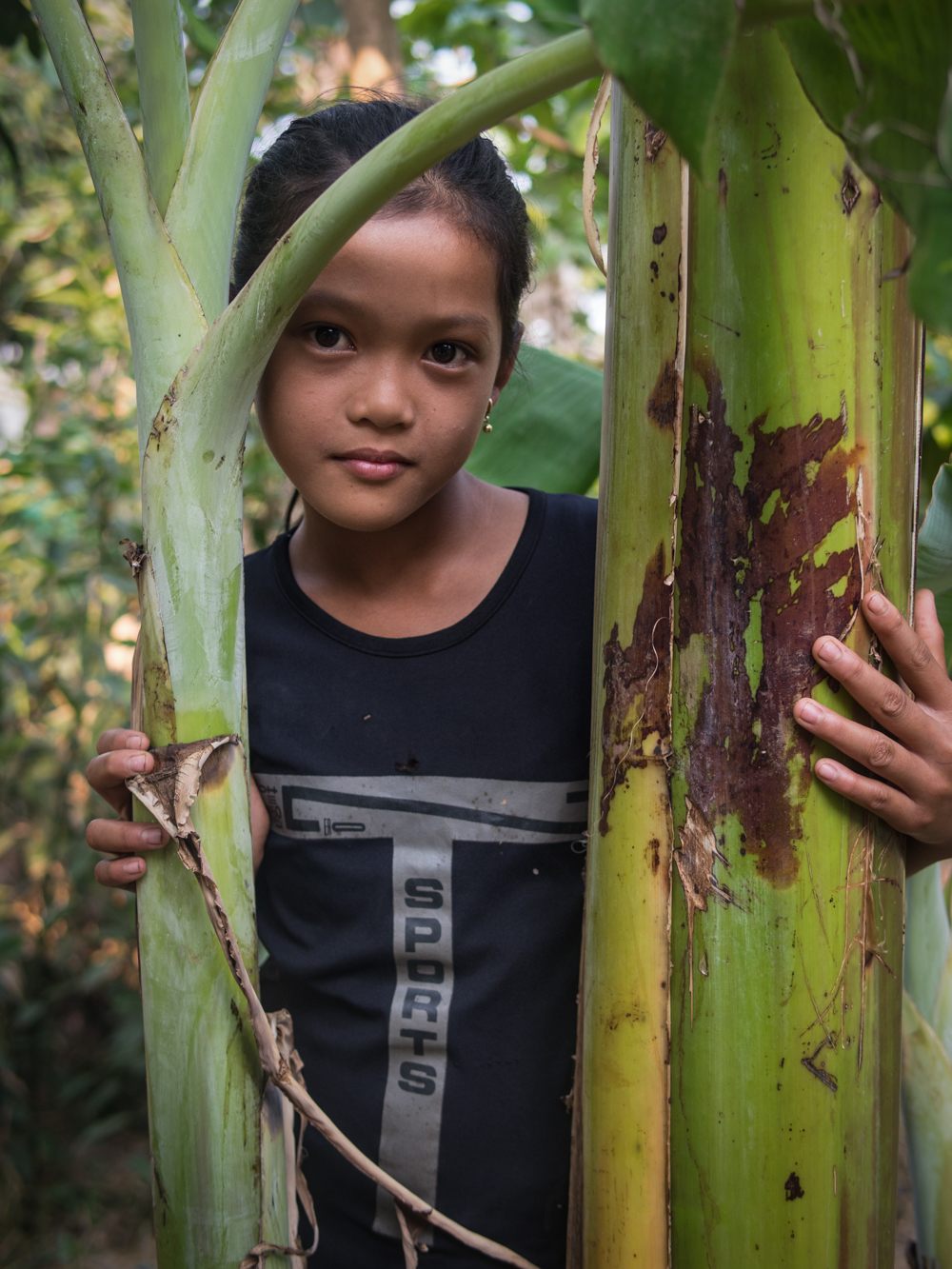
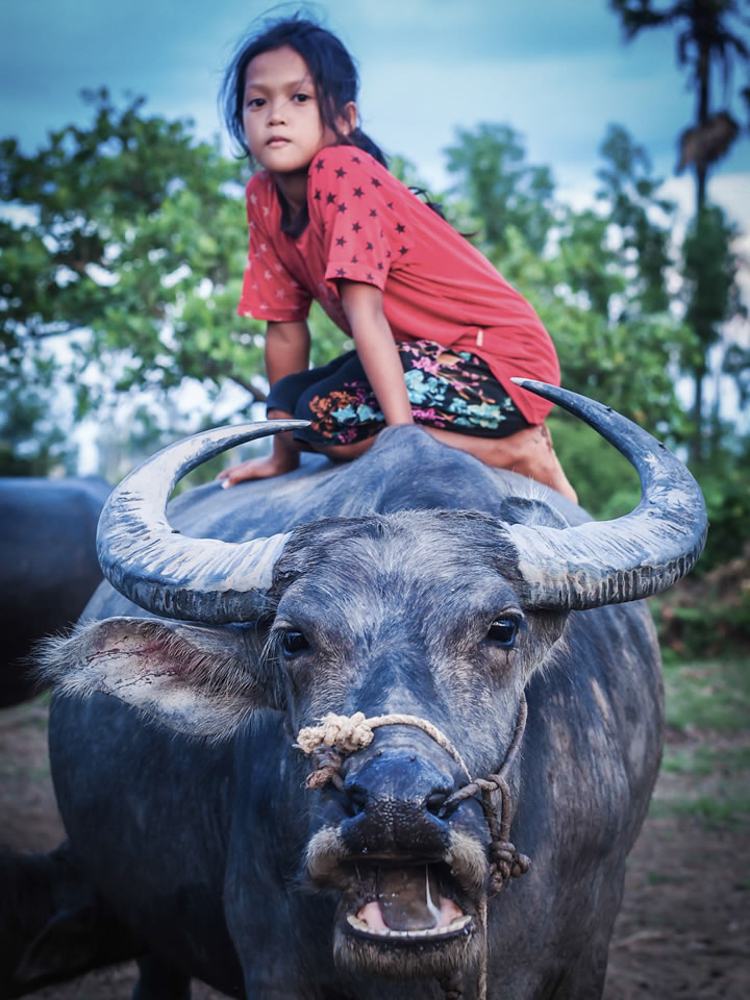
The ease and comfort of which we were able to jump off our scooters and start interacting with people who spoke next to no English was heartwarming. My favorite portrait I took in the week I was there came on my return to Ganesha as a man and his two daughters were herding in their water buffalo for the day.
The eldest girl had been left to fetch the remaining buffalo while it’s calf and had just been tied up. Impressed by her herding skills, I tried to ask her if she ever rides the buffalo, making hand gestures to illustrate my words, yet she just looked at me confusedly.
I said goodbye and was about to start my bikes engine when I saw where the girl had moved to. Whether I’d inadvertently instructed her to pose or she just wanted to answer my question in a physical way, I took the key back out of the ignition.

I printed out the shot and found her the next day. Her family were overjoyed, yet she seemed underwhelmed. Perhaps she wasn’t a fan of the color isolation.

I’ll have to return with a better print next time.*
Kampot’s tranquility maynot last forever. I heard stirrings that it’s the ‘next big spot’ for travelers. That’s ok, because no visit to the same place is always identical. Change is inevitable and there’s always another great spot under the radar. What remains, however, is the overwhelmingly warm and open spirit of the Cambodian people, who are usually willing to engage with you if approached.
These interactions are harder to do in more developed parts of the world, with the hectic pace of life and people’s heads glued to smartphones, which is why spending time in a place like Kampot isn’t just a good idea – it’s essential.

This article was originally published in Busan Haps Magazine, which you can see here.
* I returned with a better print two years later, you can see that trip here
Join my Facebook page here.

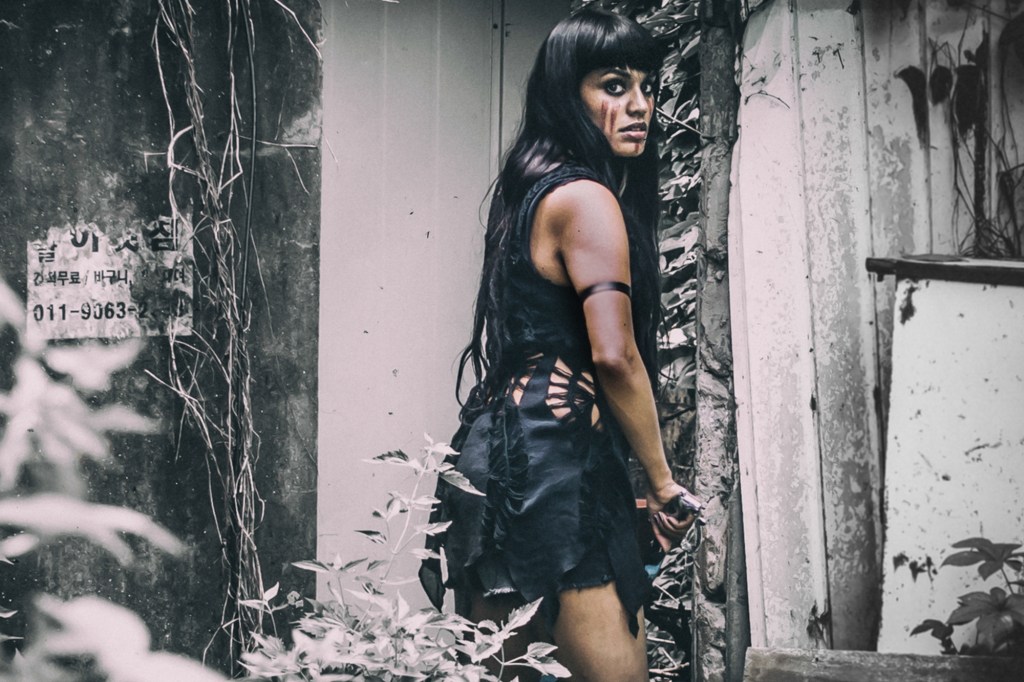
Neo Seoul, South Korea. 2047.
The immigrant massacre of 2045 sparked an uprising halted by a titanic explosion that cast a dark, toxic cloud over the capital.
Nobody knew for sure who gave the order, though most had an idea.
In the run up to the blast, rumours had been circulating that underground Samsung labs had been engineering military weaponry alongside their well-known surveillance program.
When the virus spread it was devastating. After two weeks, Seoul was a ghost town. Six weeks later, the whole peninsula was quarantined.
Five years later, Korea remains a no-go zone outside of military juristriction. The concrete wastelands of neo Seoul now harboured the last remaining civilians, who’d returned for resources.
Only one foreigner – the Outsider – remained.


Nothing is ever completely lost.
Where there is light, a rose can grow from concrete.

The uprising.
What were we trying to do?

We should have just got the hell out, before the explosion, before this virus I feel pulsating through my veins.
Before I became the monster staring back through these blood-stained mirrors.

Every lab led to fresh clues, new hope for an antidote.
Everyone was one of us here is infected. Some of us have fared better than others, but the virus will kill us all eventually.
That is, if we don’t kill each other first.


People say giving yourself up means becoming fresh fodder for the testing labs.
Not much is known about life beyond the quarantine zone, but the Samsung logos adorning military patrol uniforms tell their own story.


Birds of prey have the best vantage point. Death from above.
Hunt or be hunted. There are no allies here.
I used to fear the screams.


Fear…I miss that.

Gwanghwamun Square, central Seoul. We were engulfed by a sea of yellow jackets and riot shields, some marching, others running. Most were strategically cemented in formations. It was a national holiday, ‘Liberation Day’, which marked the freedom from Japanese occupation. The massive presence of authority hardly echoed the day’s sentiment.

We were passing through when, in the blink of an eye, some friends and I latched onto a protest march. It was something about workers unions and injustice and down with the system. One lady was nude with full body paint. Another wore kinky leather, handcuffs dangling and strutting as if she’d sprinkled cocaine on her cornflakes. She shouted something simultaneously angry and uplifting toward a group camped under an open air tent, who promptly responded with cheers and pumped fists.
Coming to an abrupt halt, we found ourselves signing a petition to launch an independent investigation into the tangled web of Sewol-gate. A parent of one of the victims was there, Kim Young-oh, who’d been fasting for 33 days on nothing but salt and water. He was willing to die for justice.
The messy handling of Sewol spawned wide-spread public anger amid claims of government incompetence, not only merely their response, but also the how the causes were evaluated. Shame-induced suicides, cult leaders and claims of corruption all rose out of the murky depths of an ocean of misinformation.
The lack of enforced safety regulations during Korea’s economic rise came to the fore with Sewol, a ship that was overloaded with cargo on a regular basis. That incident preceded a summer of health and safety disasters in the capital which included fires, collapsing buildings, sinkholes and subway collisions. The most recent incident involved 16 people falling to their deaths through a poorly-built vent grate at a concert. Even a giant rubber duck, brought to Seoul to cheer people up, has been placed in a dangerous location.
South Korea may now be included in the list of OECD countries, but in light of 2014’s string of man-made disasters, ‘developed’ is very much a relative term for a country that’s taken so many shortcuts on it’s route to riches.

You might ask why it was a good idea for someone to stand on a grate in the first place, let alone as many that caused it’s collapse. Did people mindlessly adhere to one another’s illogical behavior? Some critics pondered why young victims of the Sewol obeyed orders to stay below deck so rigidly, wondering if it was linked to a culture that obeys authority figures more readily than other countries.
Sometimes when I see crowds hypnotized by that little red man in the traffic light box, glued to their standing positions regardless of visible traffic, I’m fine to go along with the hive mind theory. Perhaps it’s my small town mentality. Since Sewol though, i’m amazed at how many people have been taking a stand against alleged incompetence toward the ruling elite.
It’s hard to pinpoint the Korean mindset. If there’s a herd mentality here, it’s more evident in social etiquette than in governmental obedience. From citizens switching social networking apps for fear of being spied on, to journalists and artists being arrested, the powers that be are becoming increasingly suspicious about an increasingly cynical population.

We left the protest tent, still on the same small strip leading from Gyeongbok Palace to nearby Gwanghwamun Station, and emerged onto the fountain area under the guardian gaze of legendary Admiral Yi Sun-sin. This is a tribute statue that represents more than a man, but a state of defiance.
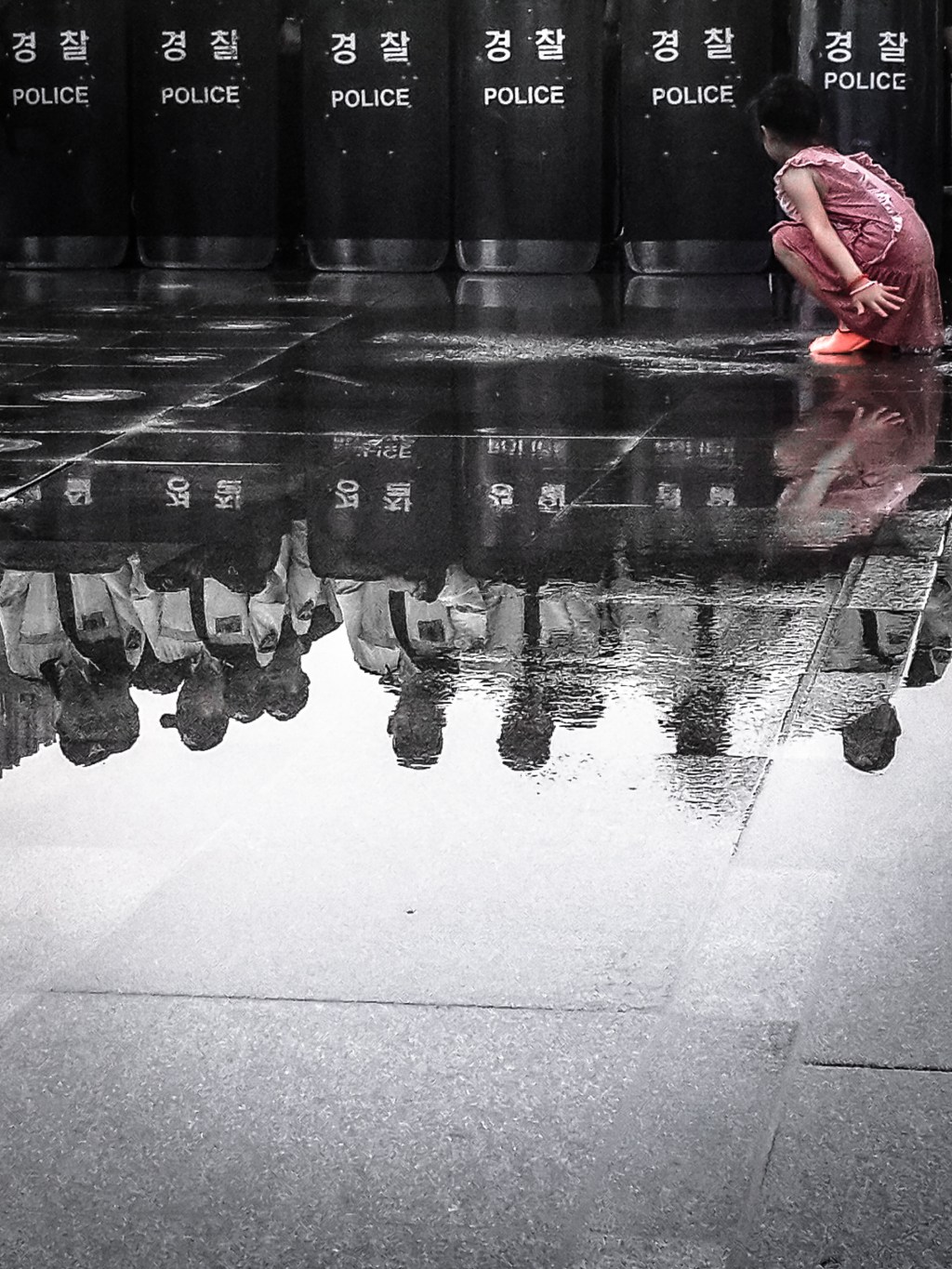
There were children playing about in the puddles of fountain water. They ran and rolled about completely unperturbed at the fact that they were not only in the midst of interweaving protests, heavy police presence and pre-pope religious ceremonies, but they were also sitting in the watery reflection of lines of riot shields.
The whole scene looked like a Banksy piece come to life. As I began to compose a frame with the police and puddles with my phone, a free-spirited young girl approached the man-made barrier, walking directly under the Admiral.

Nonchalantly, she turned her direction alongside the officers, following watery reflections as if the shields were mere stepping stones.
In a flash she jumped down to the ground , looked up at the darkness in front of her and splashed away in an act of carefree irreverence.

Could it have been an echo of Admiral Yi-Sun-sin’s defiant nature? Perhaps a metaphoric echo of the Sewol disaster? Of course, it was nothing more than a child who, along with the nearby protesters, showed the true mark of liberation – the ungoverned expression of the human spirit.
See more of The Secret Map at the Facebook page.
A version of this article was originally published in Photographers in Korea
Learn more about Kim Young-oh here

You step off the bus to see a lone ajumma waiting as the only passenger for the next ride out of town. You cross the road to see four sets of fishing overalls hung up next to a convenience store with a muddy inflatable raft propped up covering all but the entrance. Your motel’s on the same block opposite a huge river carved into towering limestone mountainous valleys. Welcome to Danyang, South Korea.
The central market showcases the town’s speciality, with an entire strip selling nothing but garlic. A simple lunchtime order of Samgyeopsal saw the owner pop out on three separate occasions to buy the meat and makgeolli. Coming from Seoul, a city teeming with heavily staffed, busy restaurants, this stripped-down dose of country life is stimulating in it’s simplicity.


I’ve always wanted to hop off a local bus in the Korean countryside and wander through the small, traditional villages. So, along with some friends, I did just that. Strolling through the organically-grown dwellings we saw all manner of giant insects, from praying mantises, crickets and lizards to countless Golden Orb spiders and snake skins shed on the road.


We saw kids wading through streams with fishing rods, while others were completely submerged, hunting with spearguns. Families gathered together for the harvest holidays in bungalows surrounded by all manner of vegetables from corn in the fields to pepper gardens and pumpkins on the loose stone walls.

Whilst walking along rice terraces as the sun was went down, the soothing sound of birdsong replaced the familiar constant traffic hum of Seoul. It was like hitting the reset button to all the stress of the city. A rewiring of the senses. The natural rhythms of the countryside are a cure-all to the mechanics of urban living.

Stepping inside a temple complex let’s you step outside a sense of time. Maybe it’s the fact people go there to escape the daily, external grind and attempt to find inner peace. The visually arresting architecture, which the vast array of buildings at nearby Guinsa display in abundance, can induce an altered state of mind, especially with the chanting of monks drifting through. With over 50 buildings and counting, Guinsa is a world unto itself.

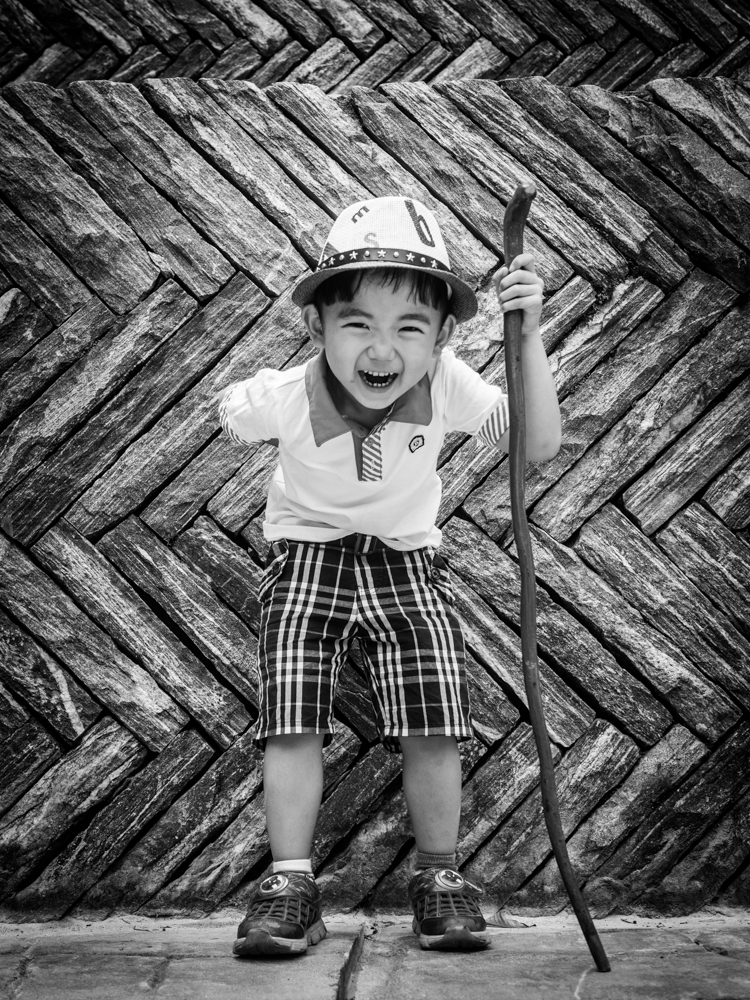
The steep mountainside slopes the young and old alike endure here are great for watching life unfold. It’s a physically challenging hike to the top, so one can only admire those toughing it out at a ripe old age, soldiering along with walking sticks in each hand.
I watched an old man with cane in hand ascend one of the final flights of steep stairs. Yet after following him round the corner he’d vanished from sight. I looked around and saw a boy – same cane, same hat. Same guy?
When I asked him for a photo he jokingly pulled the crooked back pose with his own walking stick. An old boy. As a metaphor, this regenerative feat was apt. Danyang brought back a lot of childhood memories of the small, riverside countryside town I grew up in. I still felt the physical presence of my adult self, but Danyang rejuvenated to some extent what the city had ground out of me.
Want more Secret Map on your digital devices? Check out my Facebook page here.

A recent trip to land of the rising sun has placed further evidence to a case i’ve been filing that Japan could be the greatest country in the world.
It was my fourth visit, and, flying into Kansai with my brother, we took a train straight to Shirahama beach in southern Wakayama where we met up with a friend. Thus began six days of binge sake drinking, compulsive sushi eating and excessive sunburn.

We stayed at the only hostel in town, in a lush coastal setting boasting vibrant green and blue hues in every direction. After a short walk to scout out the beach, we were taken aback to be invited by a mother/daughter/daughter’s friend trio to be guests at their holiday home that night.
We’d only been there for an hour. We promptly said yes.
The Japanese have the world’s highest life expectancy. The same mother that picked us up a few hours later was eighty years old and showed no signs of being of such a ripe old age. She was agile, beaming with energy, and drove her 4×4 with ease.
This wasn’t your average pensioner.
We were further humbled when we arrived where a banquet fit for a king had been laid out for us. Wines were ready to be emptied and premium beers stocked the fridge. At this point we were heavily regretting the decision to bring a two liter carton of cheap sake between the three of us.
As the impeccably prepared dining table devolved into a beer bottle graveyard, we were offered the spare room to bed down for the night. It was here that I got a small glimpse of this generous soul’s life.
In the picture above, she’s holding her portrait at 40 years old, half her current age.

This was from an album of her late husband. They had both built the house from scratch when Shirahama was on the rise. Even more touching than the invitation to gaze into this window to the past was the speed of events – we’d not long arrived in town, the country no less. Now I was knelt beside someone in their own home, a person that didn’t even speak my language, being shown undeserved amounts of generosity.
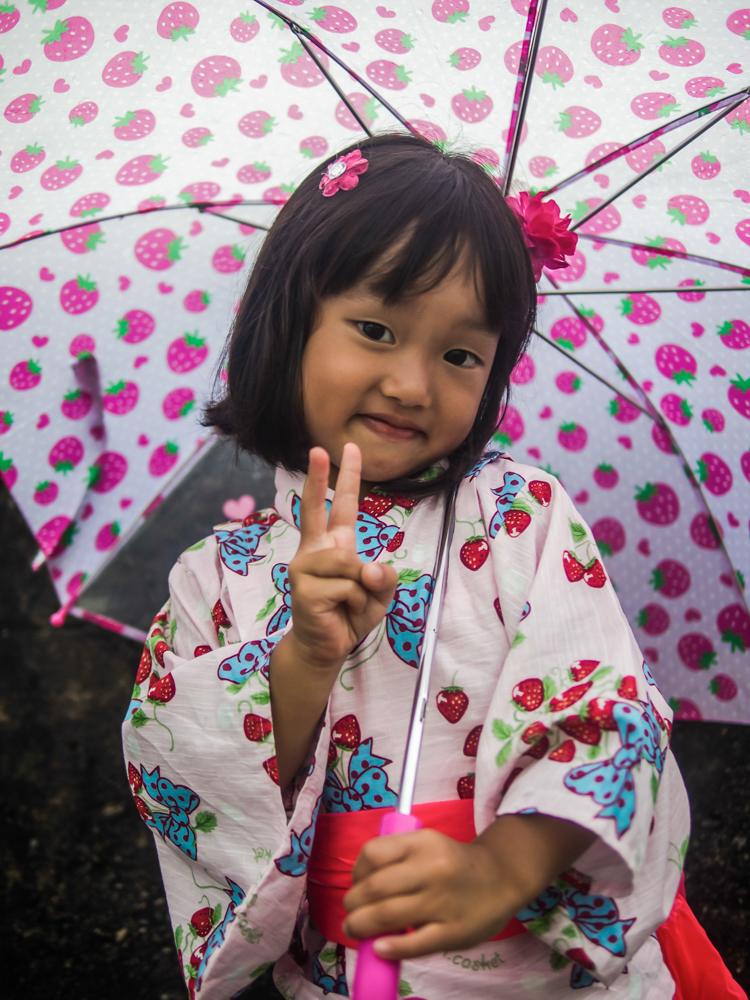
We’d only booked two nights in Shirahama, but fortune stayed on our side as we discovered that an annual fireworks display was being held on the second evening. Half the attendees were wearing traditional kimonos and yakutas and I couldn’t help but stop the young girl above for some shots of her strawberry ensemble.
When the explosions rang out, flashing over the ocean for forty minutes, they were breathtaking – the best we’d ever seen, and perfectly timed to an assortment of tunes that climaxed to an operatic number. It was at that point that we collectively broke off a piece of our hearts and buried it under the sand.
This girl was sixteen years old and about to start the 3rd day shooting for a film being cast from first-time locals. Her on-screen romantic interests nearby were both a year older. I asked the primary lover if he got to kiss her. “No”, he said with a straight face and unflinchingly tone solemn, “It’s pure love.”
Japan, Japan, Japan. What seventeen year old boy would say that in the West?

From pure love to bare-faced cheek – all of the beach goers we encountered in the three days we were there were wildly engaging with an uninhibited spirit that is too much of a rarity in my more conservative residence of South Korea. The jokers above, showing off their new tattoos, were prime examples.
What also struck us, beyond the ease of interactions, was that the Japanese love a good dose of vitamin D – quite the reverse of neighboring Korea where pale skin is a prized asset. Covering up is not the agenda at Shirahama.
Viva Shirahama.
The final three days were spent in a rainswept Osaka. The monsoon season brought rain showers as dramatic as the country’s many castles.
Have you ever seen a monk in full robes dump a stack of animated erotica onto a cashiers table of a comic book store? The same store where groups of girls casually browse for gay male fiction? The one across the street from where adult men stack baskets of cartoon school girl porn? It’s next to the maid cafes where awkward teens a few floors above will pay girls for no more than a loving gaze, whilst business men somewhere in the block opposite are being tied up and spanked.
I have. It’s weird. It’s unsettling and I can’t help but spend a lot of time wandering around places like Nipponbashi, the geeky district of Osaka where video game shops are like museums and the dolls aren’t just for cuddling. It’s fascinating to see just how deep the roots of Japanese culture are and just how far the branches have grown with regard to their current tastes and obsessions.
Japan is a beautiful and exotic hybrid of heart warming traditional values blended into the unforgettably, mind meltingly modern. If you’re willing to taste a little of each of the cultural dishes on offer, you’ll come away with a unique taste where, more likely than not, you’ll eagerly return for more.
Want more Secret Map? Come to the Facebook page.

“You ate bats with who?”
My eyebrows barely had the time to fall back into place as I asked an affable, wide-eyed, jungle guide to repeat himself.
“I ate bats with Bill Bailey!” he said again. He was referring to the popular British comedian – a seemingly obscure name drop out in the far throws of South East Asia.
I was in Tangkoko National Park, on the northern tip of Sulawesi. Sulawesi is a lesser-known, strangely-shaped island near Borneo and Bali in Indonesia. After experiencing the unique traditions of Sulawesi’s Highlands, I traveled to the northern tip of the island looking to seek out the company of the cartoonish-looking Sulawesi Black Crested Macaque.

After dipping in and out of a football tournament in the village, my friend and I booked a tour guide, a kind and wholesome lady named Renny. However, on encountering Bill Bailey’s dinner one-time dinner guest moments afterwards, we started to have doubts.
“I can get you a good photo of the monkeys eating bananas from my knee!” he excitedly proclaimed, with the excited eyes of a teenager, though he seemed mid-forties.
As a portrait photographer, his pitch was appealing. I envisioned him knelt down, banana-baiting a salivating simian as I got some dreamy up-close shots of these fascinating creatures, better known to the world as the infamous ‘selfie monkey’.

“Come and watch a video of me eating bats with Bill Bailey tonight.” Sure enough, that evening, I witnessed the troll-looking British comedian breaking bat with our energetic new friend.
We watched Bill Bailey’s Jungle Hero, a BBC travelogue that saw the intrepid Mr. Bailey traverse through Borneo, Brunei, Sulawesi and New Guinea following the footsteps of Alfred Russel Wallace. Wallace, the British naturalist and explorer had been “airbrushed out of history”, according to Bailey. The documentary was his way of paint stripping the walls of history, roughly speaking.
It was in and around Tangkoko that Wallace noted a physical divide between the animals in Sulawesi, which were Australasian in origin, and the animals in nearby Borneo which are classically Asian. The separation was due, in theory, to land movement. The divide has since become known as the “Wallace Line”.
In correspondence with his hero Charles Darwin, Wallace collaborated on the theory of evolution, subsequently jointly published along with Darwin’s papers. Darwin’s The Origin of Species followed, allowing Darwin to take the glory, whilst Wallace’s name was consigned to the history books.
The bat-eating guide would be a hoot, but we’d already made an agreement with Renny.


After witnessing a group of Tarsiers (the tiny primates that inspired the creation of Yoda) return from a night’s hunting at 5 a.m., Renny and her sister led us to ‘Rambo 2’, the most friendly of the four troops of Black Crested Macaques. Yes, it was named after the Stallone franchise.

As we walked through the forest we noticed the snapping of twigs from all directions, and suddenly little black figures darted into our peripherals from all directions . Being used to human contact, they weren’t at all worried by our presence, and before we knew it we were part of their primal quest for berries, grooming, play fights, and nap spots. The simple life.


Rambling through the foliage with the black crested macaque is an overwhelming sensation, like stepping through a screen and onto the set of David Attenborough’s latest project.
Despite an initial time limit, Renny allowed us to follow them for as long as we wished. This was testament to hers and her sister’s love of both the ‘macaca nigra’ (as the macaques are locally know), the jungle, and the art of guiding.


As a second day’s outing came to its end, the alpha male of Rambo 2 looked particularly at ease. Renny called me over to come and sit with him. His relaxed yawning revealed massive incisors. As big as his teeth were, he was completely relaxed and non-threatening, though I kept a respectful distance.
Then he did something remarkable. As Renny sat down nearby him, he got up and walked over to her, sat down and placed his hand gently onto her outstretched boot.
They locked eyes.

If there was a line dividing species here, it wasn’t overly apparent in this moment. The look between them painted a picture no amount of banana-baiting could match
This article was originally published in Busan Haps.
More of The Secret Map can be found on the Facebook page.
The conservation efforts of Tangkoko National Park can be seen at selamatkanyaki.com and on their Facebook
Renny can be contacted for guide services at Renny_linggar@yahoo.com and she operates from the guesthouse Tarsius.
Here is a video I made from the trip:
“Escape through travel works.”
Alex Garland, The Beach.
I’d grown tired of it. Tired of the jostle and hustle and those countless faceless bodies colliding with me from every direction. Weary of the endless streams of traffic filling any empty spaces of my lungs which the dirty Beijing breeze hadn’t already blown in. I’d dreamed of living in Seoul for years, and I love it, really I do. Yet the constant warring for subway seats, the side-stepping, dodging and weaving between streams of slow-stepping smartphone-entranced commuters had started to grind me down.
I’d barely been here a year but I need out. Not out, out. Just enough of an escape to keep me going. The city life turns me on, no doubt about it. But after a countryside upbringing, this existence amongst the haze and giant grey Lego bricks that makes up Korean city architecture could sustain my sanity for only so long.
My mum had come over from England for her second visit. I’d been trying to convince her to hop over to Japan from the time I was there last. Japan was a safe bet. Temples aplenty and natural beauty in abundance. What else was left to do in Seoul and it’s surrounds? Take her to Lotte World? Better off staying at home.
Yet she loved and missed Korea, and on the eve of Buddha’s birthday come back she did. After a few days in Seoul, she said that we should go visit somewhere I’d never been before. I said I’d always wanted to go South West.
The next day we found ourselves in those exact coordinates.

Alex Garland wrote in his novel The Beach that “Escape through travel works”. It does. From the moment we left Seoul’s grey urban sprawl, our train journey was engulfed by the sweeping views of watery rice paddies and little villages. All the way down was all mountainous farmland where abundant greens filled my pupils as I gazed out the window. Most significantly, there were very few gray areas. Why do I keep forgetting that the countryside exists here?
The first stop was Damyang bamboo forest.

Of course, being a national holiday, the entrance to the forest was packed with florescent jacket-clad Korean tourists. A middle-aged karaoke queen near the front gates knocked out a rendition of ‘Holding out for a Hero’ that carried heavily through the stalks as we made inroads.

Yet as we continued on, it was surprising how large the place was. I had expected a tiny fake forest full to the brim with couples slugging selfie sticks. As we continued to higher ground, however, the masses thinned out. By the time we reached the other side, we were virtually alone.
Why were there so many people near the entrance? Why do they walk slower there and wait in long lines to take pictures when the rest of the park is equally as attractive? Or do you just take things for granted the more time you spend around something? Maybe that was it.All I know is that the further away you go from the places that everybody else is trying to get wonderment from, the more of it gets sucked out of your own.
We made nearby city of Gwangju our home for the night when a kind man named Pedro Kim welcomed us into his very homely and entirely empty guesthouse. We didn’t spend long there though, we had a birthday to attend.


Buddha’s birthday was in full swing when we arrived. Thousands of glowing lanterns and a room full of monk-led chanting in the main temple made it worthwhile as an experience. Yet it was a Korean lady who approached my mother and told her she looked like a friend she’d met in England – her guardian angel no less, that made it worth remembering.
“They drive it like they stole it.” remarked my mum on the bus to Boseong the next day. She had a point. As the guy hurtled around corners with the ferocity of a Formula One racer, we both reached for our seatbelts. Even amidst the laid back countryside setting outside, we could have been on a bus in Seoul except that the roads were less busy out here, and the driver was taking full advantage of it.

We had to wait for a local bus to take us to a green tea field plantation. We waited among very weathered and life-beaten elders. I wondered what was going through their heads as they sat there staring out of weary eyes, looking like they’d lived a truly full existence. They’d run the gauntlet and were nearing the end, but with tools, pots and vegetables to their sides, they were still very much active participators in the game of life.

The older generation down south of the peninsula are amazingly hospitable and welcoming. Instead of the constant phone tapping that occurs on city transport, we heard loud chatting amongst themselves, toward the bus driver, and they even talked to us and the other foreigners that were headed the same way. They let us know where to get off the bus too.

I really didn’t want to follow the pale foreigners. Their accents were whiny and they said the word “like” too much in a single sentence. You could hear them from a mile away. It was like, so annoying. Goddam tourists.
I couldn’t follow them straight to the main fields. Once on the premises, we decided to veer up a hill and continued up until we saw signposts. We took the unmarked path. The thick blanket of multifarious trees started to thin out as we went higher. We’d found ourselves on the other side of the mountain now and had probably left the area we’d paid a ticket to visit.
We were on the verge of turning back when there was a path cutting through the trees which led to the following view..
“Tourists went on holidays while travelers did something else. They traveled.” Alex Garland, The Beach
When you travel, the further you go from the decompression zones that are the tourist belts of the capital cities, you see less and less people that look like you. You start to feel like you’re blending into the culture the more you shake off your stabilizers of banana pancakes, smoothies and English language signs to help you along the way to your next well-reviewed destination.
Sure, there was nothing separating those other foreigners from my mum and I in essence. We we all looking for a sense of wonderment. Yet as we stood gazing out at the most jaw dropping vista I’ve yet seen in South Korea, where a panorama of green tea bushes prime an ocean view laden with islands fading into the distance, there was a certain satisfaction that we’d made the extra effort to get here. This wasn’t in the guidebook. There was no ‘photo zone’ sign and merchandise shop. There’s a good chance we were probably trespassing. it was great.
Not one whiny voice pervaded the air, only birdsong. No fat foreign butts waddling around or florescent Korean hiking gear to blotch the landscape, just beautifully cultivated natural bliss. We’d separated from herd and reaped the rewards. We were better than them. For we were travelers.

We’d stayed in the city of Suncheon for the night and the next day we headed toward a temple in the mountains, Seonamsa.
Maybe it’s busy on the weekends, or holidays, but barely another soul passed our way as we walked along the trail and into the premises.

This place practices the of type of Buddhism that my local temple is Seoul is part of, which is Taego. It’s a practice which is seemingly shamanic in origin and places an importance of being in an area of exquisite natural beauty. The temples also have cool dragons built into them.
“The only downer is, everyone’s got the same idea. We all travel thousands of miles just to watch TV and check in to somewhere with all the comforts of home, and you gotta ask yourself, what is the point of that?” – Alex Garland, The Beach.
The guesthouse we were staying in had an enormous flat screen TV. It was tempting to veg out for the night and watch a film. But as in the above quote, what would be the point of traveling in the first place? We asked where was good to eat, and a Canadian dude named Ted walked us to the other end of town where we proceeded to eat a fish feast fit for a king for a mere eight dollars per head. Washed down with a good amount of soju, of course.
On the way home we came across a band called Acoustic Dabang who were about to practice in one of the only places left open, a tiny but incredible little cafe called Honey Pie. Luckily we were allowed to watch their whole performance as the only two customers. Two songs in and we were both almost in tears, the female singer, Sewon, had such a powerful voice that we got carried away with her in a song called ‘Lonely’. It’s these unexpected gems of moments, people and places that really make it worth getting out there and exploring the world. The longer you spend gazing at the TV, the computer or your phone, the less these moments will occur.
The last thing we did in the area was watch the sunset at Suncheon Bay.
Although switching between a phone and reality isn’t a healthy thing to do when trying to encompass one’s self in the natural environment that I’d been so longing to do since living in the city, it has it’s advantages. One of these was that I discovered that it was Mother’s Day in Korea. Another was, as my mother walked into the sunset, I thought to myself what a perfect moment it was – i could get a great filter on it.

I didn’t want to travel in Korea. I didn’t think there was any sense of wonder or discovery to be found. I was wrong.
Not only because we’d seen incredible natural landscapes. We’d also discovered countless moments of wonderment the likes of which you’d never know from a guidebook. They don’t tell you directions toward these unique experiences – the band in the cafe, the lady who greeted my mother at the temple, the sense of pioneering after escaping the tourists at Boseong.


“Is is always like this?” asked my mum, as we were suffocatingly squeezed against the front window on the bus of the journey, going back to my home in Seoul. I couldn’t answer her. I didn’t know really. Sure, I can sometimes get a seat. Mostly i just think of transport in Seoul as human cattle carriers, with every square inch of air pushed out in favor of getting as many people on as possible.
It’s not the bus driver’s fault really. This city has too many people. It’s overloaded. But it’s also hell of a lot of fun. I love it. But you’ve really got to come up for air sometime. You’ve got to escape.

We parted ways the next morning as she took the airport line and I took my started my commute.

She was leaving with a few bruises and scars from when she ran to catch a bus down south. The driver had hurtled into the bus stop like a madman as per usual. Whether it’s the big city or the countryside, people drive like they’re on crack in Korea.
That’s another thing about travel – for as many discoveries you make, you realize that some things never change.
I stayed in touch with the Acoustic Dabang, who sent me a recording of the tearjerker ‘Lonely’, which is from the same night:
The Secret Map Facebook page is here.
Acoustic Dabang’s Facebook page can be found by clicking here.

Dear Mom,
I’m writing you this letter because i’m going to Jeju Island today but I didn’t get to see you before I left.
Hopefully you find this letter tomorrow when I’m there.
Maybe my friends can message their mom’s to let you know i’m here.
I wish I could bring my smartphone but you have hidden it from me until I come back.
You think I use it too much right? I know I do.
You’ll be proud of me though mom – i’m going to bring my drawing set you gave me last year!

I’m so excited for Children’s Day when I get back!
It’s going to be even better than last time, and that day was the best ever.
Can you remember when we went to City Hall in Seoul and we had a picnic? The weather was so good!
I love that you said we can go back to City Hall on Children’s Day.
This time i’m going to play lots because I don’t have school that day. It’s going to be so much fun.

I love all the pretty flowers on display at City Hall. I just know that there will be more than ever before on Children’s day, because Spring came early this year so everywhere will be full of life.

First, I can’t wait for Jeju Island!
I’m a little nervous about going on a boat for the first time but also excited. One of my hopes was to go to Jeju remember?

I can’t wait to have fun with my friends on the trip and draw lots of pictures.
I told you that I want to be an artist when I grow up.
I hope there will be lots of art at City Hall again on Children’s Day.
I know you saved up lots of money to let me go to Jeju mom, remember when you thought you couldn’t afford for me to go?
But you worked hard and I appreciate how much you did to make it happen.
I almost didn’t go.
Don’t worry about me mom, i’ll be fine! Just think of me being happy with my friends.
Even though things haven’t been easy since dad went away, I know you won’t miss me too much while I’m away.
You will have lots of time to do nice things.
Don’t worry, dad will watch over me from heaven and I will be safe.
After I get back, and we go to City Hall for Children’s Day, can we go to the Cheonggyecheon stream?
I love the lanterns there. I hope it’s not too crowded.

After Children’s Day it’s Buddha’s Birthday and it will be so much fun because I want to visit a temple.
Remember when we did that temple stay because Grandma wanted us to be Buddhist?
I liked it mom. I want to do it again.

I still remember what the monk said to us.
He said: “If we could see the miracle of a single flower clearly, our whole life would change.”
I thought about that a lot. I think I know what it means, mom.
It’s about change. Everything always changes.
Everything grows and changes and finds a way into light.
I think that’s where flowers go when they die, mom. They don’t really die.
They go into light.
See you soon mom.
This was a fictional letter written as an account of one any of the hundreds of children that lost their lives in the Sewol ferry sinking. It was inspired by artwork and scenes from Seoul Plaza and City Hall on the weekend before Children’s Day on May 5th, 2014.
My mother had flown from England to visit me and mass tributes and gatherings had replaced a scheduled festival. We were struck with the weight of collective respects being bestowed upon the victims of the tragedy.
This Children’s Day, the bodies of many of the children who boarded the Sewol will still not have made it back to their families, but their their spirits are no longer amidst those cold oceans. They are in every letter written on every one of the tens of millions of yellow ribbons. On every message board and every candle lit in remembrance.

“After your death you will be what you were before your birth.”
– Arthur Schopenhauer
You can see more of The Secret Map on the Facebook page.