The Secret Map

Travel Essays by Simon Slater

  • vagab

    Just the other day a homeless man entered a restaurant  I was eating at.

    I was in Suwon, a city just outside of Seoul, where the sightings of vagabonds are few and far between.

    In a country of burgeoning wealth, the man’s entrance had been a surprise. Homelessness  here is usually visible in a collection of common places – outside Seoul’s central train station or bowed down next to collection trays  at subway entrances. Entering this small, presumably family-run restaurant and asking for help was a surprise.

    To put his plight into a wider context, a recent New York Times article pulled up some sobering statistics:

    The relative poverty rate among senior citizens in South Korea is 49.3 percent, the highest of the industrialized countries. Public pensions tend to be small. And the suicide rate for senior citizens, surely an indicator of economic strain, is the highest among the industrialized countries, at about 80 for every 100,000 people.’

    I’ve read somewhere that you’re more likely to give money to a rich man than a poor one, as his could lead you to repaid in another form. Was that why I had turned the cheek other cheek – because he had no value to me?

    I don’t know. Perhaps. It’s easy to ignore a stranger. Especially when they don’t speak your language. 

    Turning my head back to my friend, I continued the meal and conversation without a second glance.

    After five minutes I’d not heard the clattering of the bell signaling his exit. Curiously, I glanced backwards and saw that a group of elderly patrons had passed him a glass of beer.

    It was an unexpectedly friendly gesture – far more so than tossing some coins his way.

    IMG_20131111_191111

    Time passed, and a second glance revealed he’d been invited to join them at the table.

    A Korean barbecue table has a built-in grill that is designed for sharing. The man, now sat down and chatting away was being offered some of the mouth-watering sizzling meat  on display.

    He must have been tempting to stay and have his fill, but after a couple more minutes the gentleman was on his feet again, respectfully thanking his hosts, bowing and saw himself out.

    He had made sure not to outstay his welcome, and never once was he approached by the owners to leave.

    20130904_201454_LLS

    Why was it that these customers not only engaged with him, not only helped him out, but sat him down as a guest?

    The two couples  the man had joined were in their 50s or 60s – perhaps that’s the spirit of a bygone era? One could say it’s in the national character to pull together and help each other in times of hardship – after all, it’s what South Koreans did to raise the country’s economy from the dead – albeit under the stiff iron fist of tough presidents and military dictatorship. Was this an example of “Jeong” (정), the Korean term for the permeation of tender feelings between individuals through unconditional acts of sharing?

    Or perhaps it was simply a random act of kindness, regardless of what country we were in. Maybe they were just genuinely empathic individuals who saw a person in need of not only some food in his belly, but a few minutes indoors and a little companionship.

    The answer was blowing in that cold January wind.

    As the man walked  out under the flickering neon lights of Suwon that evening, however, he must have felt that little bit more warmth for experiencing such dignity. That brief moment of acceptance surely must have given him hope.

    After all, if his country’s past resilience has given him any food for thought, it’s that being down and out doesn’t necessarily mean being out for the count.

    vagabo

  • Corporate Hordes

    DSC_0031 2

    “You can even say the Samsung chairman is more powerful than the President of South Korea. Korean people have come to think of Samsung as invincible and above the law.”  Woo Suk-Hoon, Author.

    South Korea is a corporation nation. The most common ambition to aim for here  is to work for a large organization such as Samsung, SK or LG. The central role that these export-driven businesses have in an individual’s life here is partly responsible in changing the fortunes of Korea’s economy to being on par with Afghanistan in the 60s to being part of the G20.

    In the Far East, a corporation is an extended family. After joining  an organization straight from university, young men here usually stay at the company for life, climbing the ladder and spending more time with work colleagues than their own family.

    Businessmen frequently return home around midnight – if at all, in some cases.

    Brand logos in sport are ubiquitous around the world. From the sponsors’ brand name on team shirts, billboard advertising, post-match interview booths and attached to the names of leagues and tournaments.

    Purposeful exposure is advertising and spectator sports are fueled by it.

    South Korean sponsorship takes branding one step further.  The names of their sports teams are typically that of their corporate owner. This is because the teams have been owned by these companies since their inception.

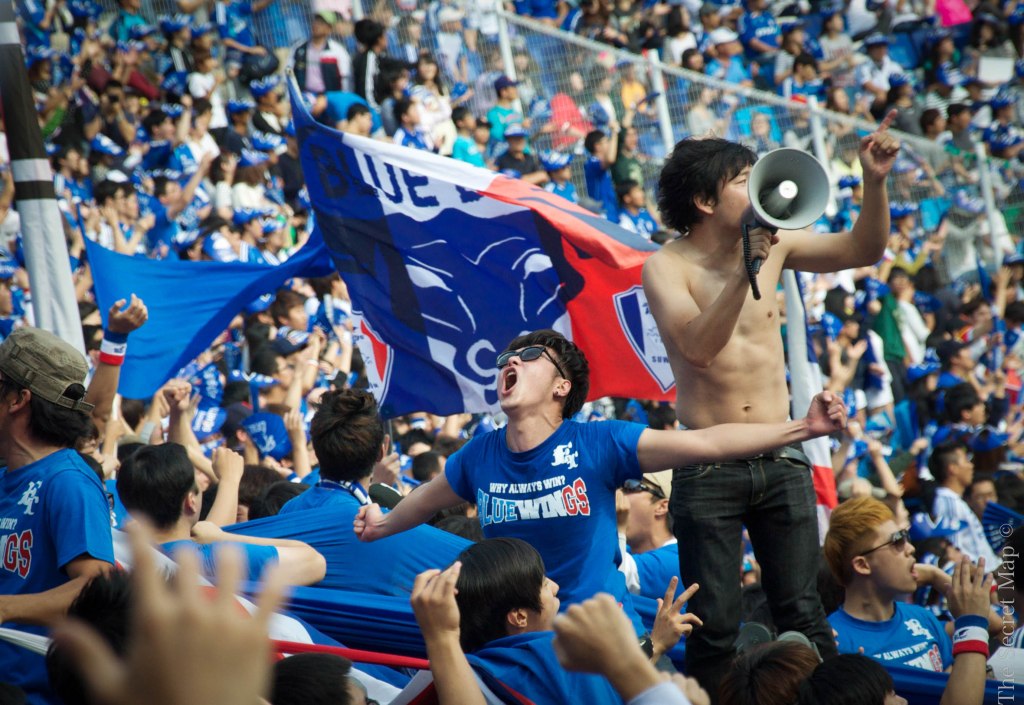
    Take, for instance, Suwon Samsung Bluewings.

    DSC_0050

    Suwon is a city a little south of Seoul. Samsung is the city’s biggest employer.

    On weeknight Asian Champions League nights, the majority of the stands are mostly empty.

    DSC_0607


    However, the megaphone wielding crowd dynamos, rumored to by funded by Samsung, is enough to get the Bluewings hardcore toward a sufficient level of rowdiness. Rumors though they are, it would make sense as these crowd-rilers barely spend any time watching the game itself.

    DSC_0068


    The celebratory player above, Bluewings’ former Yugoslavian center half Mato Neretljak, is one of a handful of predominantly Brazilian foreign investments continuously rolling in on the back of Samsung’s allowance over the years.

    The five teams that started the league were named The initial five clubs were Yukong ElephantsPOSCO DolphinsDaewoo RoyalsKookmin Bank FC and Hallelujah FC, the latter of which belonging to a Christian organisation.

    Samsung also own the basketball team Seoul Samsung Thunders. Names of other teams in the league include Wonju Dongbu Promy, Ulsan Mobis Phoebus, and Incheon ET Land Elephants (formerly Incheon Daewoo Securities Zeus).

    IMG_0856

    Basketball is a simple enough game to understand, so Korea likes to bring out a plethora of visual and interactive stimuli. Between quarters the hordes of logo waving spectators will be cheering along a dancing Samsung phone, or perhaps a cartoon-like figure with a branded ramyen bowl for a head, all the while cheering for their team, which, of course, is this instance is “Samsung!”.

    IMG_1035

    IMG_1030

    This is advertising on just on steroid, but on Heisenberg grade crystal meth.

    The best ingredient in this chemistry, however,  are the pom pom girls.

    IMG_0854

    IMG_0867

    It’s worth coming for the side shows alone.

    DSC_0022   DSC_0036

    At a volley ball match in Suwon, i was presented with the opportunity choose between rooting for Seoul Woori Capital Dream Six or Incheon Korean Air Jumbos.

    DSC_0016

    Basically, a bank or an airline. Fresh off the boat and initially naive, it didn’t take me long to realize that i wasn’t witnessing an uncharacteristically athletic group of salarymen.

    DSC_0031

    In the end, i sat closest to the best source of crowd motivation.

    Obviously, a home team’s location will go far towards supportive leanings, but here in Korea, the corporate tag is equally influential.

    What choice to make when person’s local team are his company’s biggest rivals? Does it fall on childhood favoritism or does one adopt  their adopted side?

    What of the players? Do they care about their fans and the club’s seemingly  hollow heritage?

    Maybe some, but 2012 saw 11 players from the Korean Volleyball league hit with lifetime bans in relation to match-fixing. 2011 saw almost 50 footballers from the K-league also banned for life, resulting in a hotel room death accompanied by a match-fixing-related suicide note.

    Investigations have now begun for other sports, such as baseball, basketball and, more bizarrely, Starcraft tournaments.

    Does that concern us, the casual observer? Does it affect us? Aren’t sporting events just a good excuse to get drunk with your friends, shout an equal amount of abuse at highly-paid strangers, and soak up whatever drama occurs both on-field and off only as entertainment?

    One thing is for sure: the ever increasing flow of cash getting pumped into sports means that there will be no shortage of dramatic roller coasters for the corporate hordes to ride.

    Like any ride though, it’s probably best to let go and enjoy it.

    After all, it’s just a load of balls.

    IMG_1038

  •  

    “Cut off from direct experience, cut off from our own feelings and sometimes our own sensations, we are only too ready to adopt a viewpoint or perspective that is handed to us, and is not our own.”

    The first novels I ever read were by Michael Crichton. Jurassic Park, The Lost World and Congo  transported my imagination away to exotic locations, partaking in adventures that seemed almost impossible in reality.

    Talking monkeys and dinosaur theme parks are were fictitious, but never far from a future reality in the age of embryonic manipulation and rapid technological development we’ve found ourselves in.

    I’d always thought of the author of having a productivity rate equal to his creative cognition- a Steven King type who seemingly never left his typewriter, furiously churning out novels leaving little time for sleep or toilet breaks.

    Years later, one sunny day in Brighton, England, I was intrigued to find a tattered, autobiographical account of his personal global adventures in the bargain bin of a second hand bookstore. Since most of his works get the movie makeover, i was perplexed that this title had only just come to my attention.

    The first series of chapters charts his early medical work whilst studying at Harvard Medical School. Disillusioned by the strict symptom/cure order of his studies and believing most diseases are brought on by the patients themselves, he abandons his career path to become a full-time writer.

    We are then invited to follow him along to locations he’s visited on personal or working agendas. During these trips he experiments with various conscious-expanding methods to explore the power of the human psyche and the ways we perceive the outside world.

    In this respect, Travels is two-tiered: explorations of both the physical and psychological realm.

    “Intermittent panicky skepticism was to be expected whenever you stepped off the cliff, whenever you went into some realm of experience that wasn’t modeled and accepted and approved and stuck into a nice frame by society at large.”

    From swimming with sharks, encountering headhunters and gorillas or trying to shake a criminal on the run in Jamaica, his travel stories are intoxicating as they are inspiring. As he goes into each of his endeavors with a refreshingly open mind, it becomes clear that he is a born explorer, and not merely of a geographical nature.

    Be it from the underbelly of Bangkok to the heights of Kilimanjaro, it seems that the further he goes from home, the closer he arrives to a sense of his inner self through various ancient mystical practices.

    “The purpose of the I Ching or the tarot, then, is to help you get access to yourself, by providing ambiguity for you to interpret.”

    His journeys into the workings of the human psyche through traditions frowned upon by modern doctrines are always guided by a sense of rationalism. His scientific, proof-led sensibilities are regularly cut loose by his free thinking, unconstrained sense of curiosity. He believed that modern humans have lost the power to use their minds in a way that some ancient cultures did so successfully.

    He sees practices such as tarot reading and the I Ching as purely working toward a Freudian wish-fulfillment driven impulse, whereas he admits to becoming adept at reading peoples’ auras.

    “Often I feel I go to some distant region of the world to be reminded of who I really am… Stripped of your ordinary surroundings, your friends, your daily routines, your refrigerator full of your food, your closet full of your clothes, you are forced into direct experience. Such direct experience inevitably makes you aware of who it is that is having the experience. That’s not always comfortable, but it is always invigorating.”

    These ‘direct experiences’ he speaks of are unfiltered event being perceived by the self with no relation to influences outside of the moment. It’s a concept that we’re becoming increasingly isolated from in an era where everything we see has the technological potential of being so quickly documented and shared.

    As easy as it is to exist in an established, orderly society, to travel outside of our comfort zones and react to situations and people that are unfamiliar, confusing and sometimes dangerous tests what we have become, what we are made of and what we have made of ourselves.

    Whether it’s Chrichton’s inner or outer travels, he concludes each tale by summarizing what was gained from these direct experiences, and the wisdom, if any, he attained.

    Travels must surely be among Crichton’s most underrated works and a true cult classic of travel writing.

  • The Beach – Alex Garland

      beach


    “Escape through travel works. Almost from the moment i boarded my flight, life in England became meaningless. Seat-belt signs lit up, problems switched off. Broken armrests took precedence over broken hearts. By the time the plane was airborne I’d forgotten England even existed.”

    Alex Garland’s 1996 debut novel became an instant favourite of mine. Re-reading it ten years later on my first trip to the Thai islands it describes, The Beach remains as freshly written and relevant as ever.

    Danny Boyle’s film adaptation followed roughly the same plot, and used samples of dialogue and narrative, but reading the book is a much different experience.

    One of the novel’s strengths lie in the ease in which the reader gets drawn into the character of the protagonist, Richard. If you’ve only seen the film, you’d associate the lead with Leonardo Di Caprio. This not only makes it difficult to directly relate, but the movie’s insistence on an atypical hollywood romance, almost impossible for women.

    Richard has some commonly masculine attributes, such as his romanticism with the Vietnam war and his subsequent reenactments of the movies it spawned.  The novel’s stream of conciousness style prose, and it’s exploration of universal themes make it easy for both sexes to occupy Richard’s persona.

    P1040104

    It borrows themes from several sources – Lord of the Flies, with it’s doomed island utopia being searched for here, instead of forcibly formed. Joesph Conrad’s Heart of Darkness, another influence, where in both novels the protagonist seeks to break free of established modernity and seek a more primal modes of existence.

    When the novel first emerged, it described the emerging backpacker culture prevailing in places like Thailand and India. Richard, leaving England in search of a completely different culture and experience of life, he is disillusioned to discover Thai islands are overrun with the type of tourist scene associated to Spain, Greece, or their home shores.

    After being a left a secret map (inspiration) by a crazed and suicidal long term backpacker, he ventures outside of the tourist belt of Ko Phangnan to live with a self-sustained community of backpackers seemingly sharing similar ideals. This microcosm of society serves as a platform to explore the psyche of the individual operating within and outside of the group.

    Told from the first person, It’s far smarter, more narrative-driven, darkly plotted and humoured than the movie. It contains a wealth of insights into the pros and cons of modern travel, from the cliched character molds you encounter, to the beauty of living a stripped down existence.

    As much an exploration of backpacking culture as it is human nature, The Beach is a contemporary classic from a gifted writer.

    P1040135

  • Faith and the Backstreet Crucifixion

    Genesis

    “Faith consists in believing when it is beyond the power of reason to believe.” Voltaire

    For the open-minded traveler, this planet provides a diverse pool of beliefs to dip into and test the water. While sightseeing can be the carrot on the traveler’s stick, immersing yourself in a festival or two can give a better feel for a country’s core values and traditions.

    With this in mind, I headed to Pampanga in the Philippines, one of the most staunchly Catholic areas within the archipelago, where i’d heard you can bear witness to a real-life crucifixion every Easter.

    Contrary to a continent predominantly following Buddhist, Hindu and Muslim disciplines, Filipinos found their faith through their Spanish colonial roots. You don’t grasp the full extent of this until you arrive. In Angeles city, Pampanga, biblical messages are as omnipresent as the Lord Himself.  Whether splashed across Jeepneys or worn as a necklace, the intense display of devotion is inescapable.

    P1070332-2

    Over the the Easter holidays here, thousands of people make the sacrifice of carrying heavy crosses as others whip their backs into a bloody pulp.

    The Easter Bunny and his delicious eggs, it seems, didn’t make it to these shores.

    P1070396-2
    P1070391-2

    The culmination of these displays falls on the ultimate reenactment of Jesus’s fateful day. From being flogged and beaten through to getting nailed to the cross, there are devotees that go all the way shy of having nails through their feet and left for dead. Nonetheless, these people offer themselves up, year upon year, to be crucified.

           Exodus

    “I may not have gone where I intended to go, but I think I ended up where I intended to be.” Douglas Adams

    Clearing the Go-Go bars and sex tourists the city is famous for, I was killing time exploring Angeles on my day of arrival when I happened upon a gang of cross bearers and self-flagellants preparing for a long march down a traffic-heavy main road.

    After snapping a few pics, they asked if I wanted to join them. Obliging, I hopped into their van, stopping at consecutive neighborhoods as the rest of the group trudged along, increasingly bloody and out of breath.

    P1070365-2
    P1070360-2

    At each stop there were small, shrine-like chapels where the participants knelt or lay down, whipping their backs or holding up the heavy weight of their crosses. In the scorching burn of the midday heat, they arrived in progressive states of exhaustion and pain.

    P1070348-2
    P1070382-2
    P1070379-2

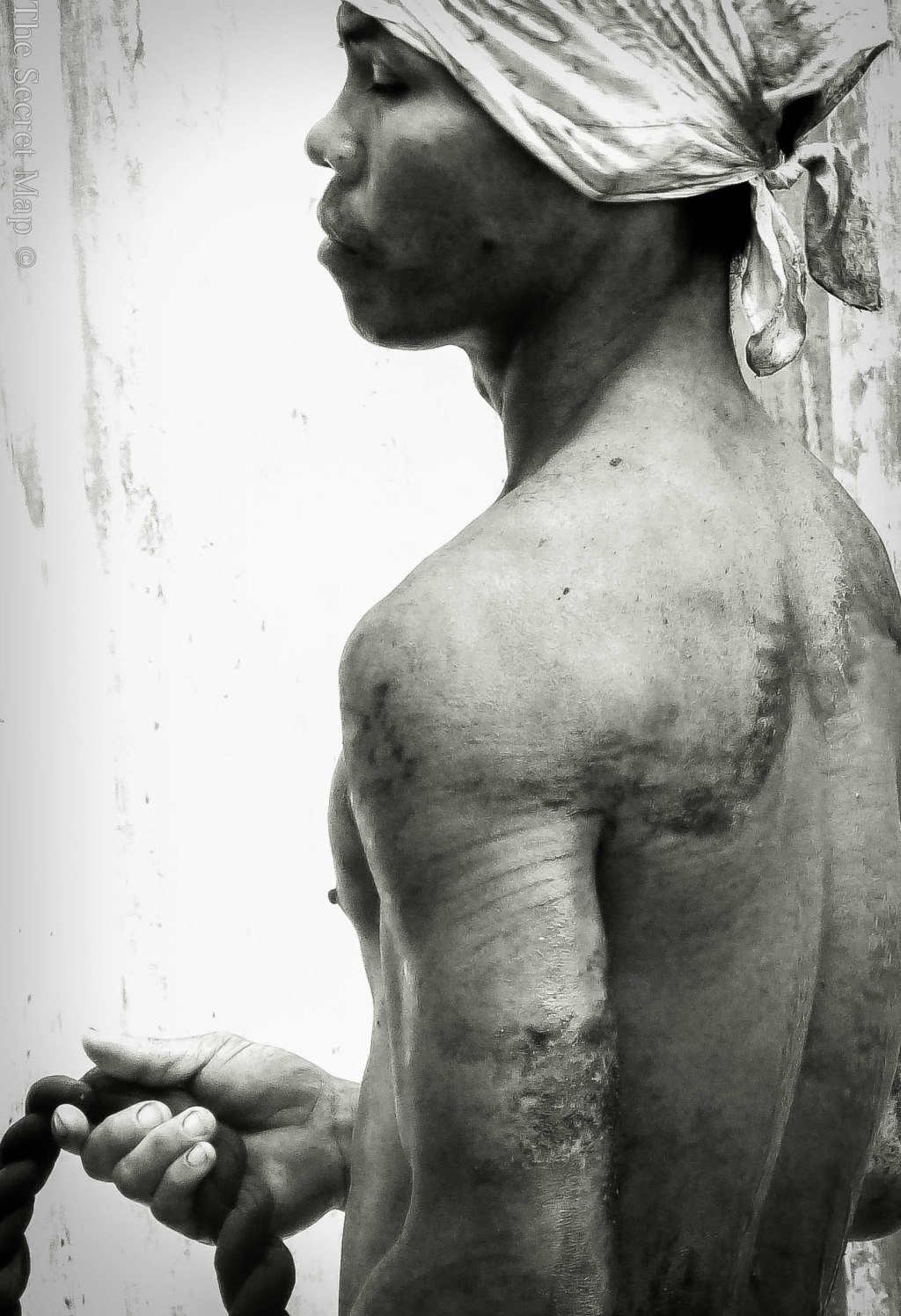
    The pain increased for the flagellates as razor blades were used to cut small incisions into their backs, which, after a few hours of casual flogging, transformed into bloody, sore-soaked wounds aptly resembling angel wings.

    P1070475-2
    P1070559-2
    P1070479-2

    The participants wore jeans, gowns and neckerchiefs to cover up from April’s punishing solar assault.

    Along the way we’d seen other groups from various barrios doing the same thing; all exhausted, all blood-splattered. We decided to drive our group’s home barangay and wait for them. A barangay, or barrio, is a small neighborhood with its own sociopolitical system. One of the biggest topics of conversations in the Philippines in April are local and national politics. I arrived just before the elections and there were more posters plastered around for politicians than for the man upstairs Himself. 

    P1070405-2

    We waited in the center of the barrio, a basketball court-come-chapel, where we listened to local girls take turns singing the complete Bible from beginning to end, which takes approximately seventy-two hours.

    P1070459-2

    Later that evening we got to know each other over brandy and a concoction of creamy pig’s face, a local delicacy. My new friends championed a backstreet crucifixion the next day = one where you could witness the action close up, rather than the distanced view of the tourist-orientated event I’d planned to attend.

    We could rent their friend’s Jeepney, they said, make a day of it.

    I was a little concerned that a member of the group who’d gone home early texted me saying ‘Be careful Simon, you don’t know who you’re dealing with.’ Ultimately, it was too ambiguous to worry about, These people I’d spent the day, and a substantial cultural exchange with, had already given me their time and plenty of hospitality, and thus a reason to place my trust in them.

    A crisis of faith

    “Fear can keep us up all night long,but faith makes one fine pillow.”

    Philip Gulley

    On my return to the city center, I found two expectant faces at my hotel entrance. They’d stopped by the group’s house where I was drinking at earlier. I must have mentioned where I was staying in conversation. They asked me if I had enough money to pay for their motorbike taxi after they’d come into town for a night out and not bought enough to cover their fare.

    A scam, and I wasn’t buying it.

    One of two, a transsexual lady, whose transition merely seemed to entail donning a wig, offered a massage in return for cash. It wasn’t the deal breaker she may have hoped for, and after much persistence, they eventually left.

    P1070633-2

    Upon entering my hotel I was told they had even tried to enter my room when I was away. The Wonky Pensioner Hotel had no security, but at least the doors had locks.

    Frustrated by these late-night developments, I sat at the hotel bar and pondered my options. Were those thieving scammers sent by the same group I’d just been drinking with? Would there be another, more grandiose scheme in store for me tomorrow?

    I’d heard a tale about a girl and her grandmother sweet-talking a foreigner into their house, drugging him up and robbing him in Manilla. At the same time, I didn’t want to jump to conclusions. I had the chance of witnessing something truly unique.

    It was a crisis of faith.

    The family and their friends had all been so generous by letting me into their lives for the day, whilst the scammers had only been at the house for a short while and I hadn’t planned on meeting those two individuals the following day.

    I stopped myself short of declining via text message and slept on it.

    Revelation

    “Faith is not trying to believe something regardless of the evidence; faith is daring something regardless of the consequences.” – Sherwood Eddy

    A phone call awoke me the next morning.

    I agreed to meet the guys in town, as arranged. I left behind my newly-purchased DLSR camera and took my compact camera, my phone, enough cash for the day and a refreshed sense of optimism.

    Meeting under the golden arches of McDonalds, I immediately asked the Barangay boss, Mark, what the deal was with the previous night’s antics. He seemed genuinely surprised and concerned, explaining that the pair were drug fiends and although he lived in close quarters to them, they weren’t to be trusted.

    Relieved and assured of my safety, I duly hopped into their car.

    Traveling along the main road, the streets were awash with rag-wearing believers wielding bloody whips, shouldering crosses and striding towards their respective chapels. Stopping at Marc’s barangay, the first order of the day was a visiting congregation of what seemed like hundreds of faithful marchers supporting crucifixes on their backs. This was merely a fraction of the thousand that’d been erected en masse earlier that morning whilst I was sleeping off a hangover.

    P1070473-2

    It was a sight of biblical proportions.

    After the proceedings, I met the crew I’d share the Jeepney we’d hired and rode out to the song of the chapel girls, who were rotating singing from the Bible and still going strong on their third day in a row.

    P1070560-2
    P1070545-2
    P1070551

    The streets were awash with families and participants with crimson-stained backs. Street vendors sold much-needed refreshments like coconut milk and halo halo amidst the blood, sweat and cheery smiles.

    Three focal participants led the procession to the final stages as they took a heavy beating from their friends, thus reenacting the Passion of Christ.

    P1070533-2

    They carried their crosses down the roads and through neighborhoods being routinely kicked, pushed and beaten with a belt until they staggered uncontrollably onto dusty ground.  A brutal ritual, but never to the point where they couldn’t rise to their feet for renewed punishment.

    P1070368-2

    We piled out of the jeepney and headed down a backstreet alley, where a large crowd had gathered, buzzing with anticipation for what was to come. Kids back in England were wiping chocolate from their mouths; here, blood from astonished brow.

    I was introduced by a member of my group to the man who was to perform the nailing. He held the nails in a container filled with alcohol to avoid infection. I was told I would get to see the nails enter up close along with an Australian, who had also met a family who could pull some strings. The fact that he had bought his DSLR camera, and I hadn’t, annoyed me less than the fact that I was no longer the only foreigner around. What was he doing here? Shouldn’t he be with the rest of the tourists at the more commercial event? I tried to not let his presence detract me from diluting my unique cultural experience.

    The more tourist-driven ceremony draws about twenty-five participants for full crucifixion, yet it seems viewers are too distant to actually witness the act and the participants are adorned in fancy, theatrical costumes.

    This, however, was raw.

    The three sacrificial devotes were dripping with sweat, and with tortured expressions, were hoisted along mercilessly by ropes attached to their waists. When they arrived at their final destination, they looked ready to meet their maker.

    There was only one man actually getting crucified today. As he assumed the position, he was the calm center of the universe compared to the chaos and fervor surrounding him.

    I bargained my way to the front, pleading to people in front of me that I would never see this again in my life. Fortunately, and generously, everyone I asked duly obliged.

    P1070595-2

    The first nail was plucked from the container and pierced firmly into the alcohol-dowsed palm.

    The Jesus-surrogate screamed with pain.

    With a swift second scream upon the pushing-through of nail number two, it was time for stage two. The wooden cross was quickly hoisted skywards levered by four ropes, which then proceeded to rotate said cross and Jesus-for-day for all to see.

    P1070606-2

    Considering the hastiness of his erection, ahem, he was on parade for quite a while.  Not that he seemed to mind – there was a distinct look of peaceful focus in his eyes.

    If the act of redemption gets you a free pass to heaven, this guy’s annual sacrificial antics has him lobbying for a golden ticket.

    P1070618-2
    cross

    Perhaps his placid demeanor changed when the nails came out. We didn’t wait to find out.

    Returning to the truck, my group headed back to their barangay after we swapped Facebook contacts and I jumped on a bus back to town. The trust I felt toward the group was the same as when I first met them. Although I’m personally not a follower of traditional religions such as Catholicism, there’s something to be said for not letting logic or reason sometimes cloud a heartfelt, trusting sense of belief.

    Putting confidence into a doubtful set of circumstances, such as when I decided to go along with these guys this day, and placing your faith in your gut instinct can be a weighted guide when making difficult decisions.

    Taking a leap of faith can be a wild gamble, for sure, but sometimes big bets can reap even bigger rewards, whether you’re on the road or any other walk of life.

    For updated Secret Map, come join the Facebook page